


 SIGN UP FOR OUR
 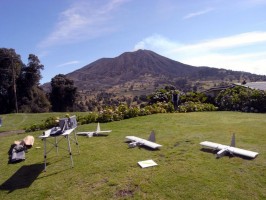 Whereas unmanned aerial vehicles (UAVs, commonly referred to as “drones”) routinely make headlines for their use in wartime operations, surveillance and invasive law enforcement, in Costa Rica they are used for science. As reported by The Costa Rica Star in late 2011, The Center for the Investigation of Nuclear and Particle Science (Spanish acronym: CICANUM) of the University of Costa Rica (UCR) utilizes drone aircraft to fly over volcanoes and other regions of the country in an effort to collect vital atmospheric data.
The use of drones in Costa Rica is part of the nascent aerospace industry in our country, and it is part of an ongoing collaboration with the United States National Aeronautics and Space Administration (NASA). A recent press release by the agency explains how recycling and 3D printing are being applied in the new generation of drones that will fly over the Turrialba volcano next year to study post-eruption conditions:
It’s more an engineer’s dream than nightmare – to rapidly prototype and redesign aircraft using 3-D printed parts. That’s just what a team of student interns and engineers at NASA’s Ames Research Center in Moffett Field, California, got to do: custom-build aircraft by repurposing surplus UAVs. Grafting fuselages side-by-side adds more motors, propellers and batteries to improve power and performance capacity. By lengthening the wings, the team was able to improve aerodynamic efficiency and help extend the flight time of small, lightweight electric aircraft.
The prototype aircraft are constructed using components from Aerovironment RQ-14 Dragon Eye UAVs that NASA acquired from the United States Marine Corps via the General Services Administration’s San Francisco office. Unmodified, these small electric aircraft weigh 5.9 pounds, have a 3.75-foot wingspan and twin electric motors, and can carry a one-pound instrument payload for up to an hour. NASA can use these Dragon Eyes to penetrate the dangerous airspace within the plume of the volcanoes because their electric motors do not ingest and are not affected by the contaminated air. The Dragon Eyes are proving to be an effective way to gather crucial data about volcanic ash and gas emissions.
he NASA team created the name FrankenEye to reference “Frankenstein.” The student teams participating in summer activities harvested parts from surplus aircraft and reanimated them using new 3-D printed parts with the goal of increasing payload capacity and endurance for use in Earth Science missions.
The Costa Rican Airborne Research and Technology Application (CARTA) 2015 mission will be the latest in a series of deployments of small UAVs, led by David Pieri, volcanologist at NASA’s Jet Propulsion Laboratory in Pasadena, California, and is supported by the NASA Earth Surface and Interior Focus Area, the ASTER Missionand a consortium of NASA centers, including Ames, NASA’s Goddard Space Flight Center in Greenbelt, Maryland and NASA’sW allops Flight Facility in Wallops Island, Virginia and the agency’s Glenn Research Center in Cleveland,as well as the CICANUM GasLab.
Flying as high as 12,500 feet above sea level, multiple small converted Dragon Eye UAVs, including the specialized and highly modified “FrankenEye” platform, will study the chemistry of the eruption plume emissions from Turrialba volcano, near San Jose, Costa Rica.
The goal of the activity is to improve satellite data research products, such as computer models of the concentration and distribution of volcanic gases, and transport-pathway models of volcanic plumes. Some volcanic plumes can reach miles above a summit vent, and drift hundreds to thousands of miles from an eruption site and can pose a severe public heath risk, as well as a potent threat to aircraft.
“The use of UAVs to carry out potentially hazardous sampling of volcanic gas emissions sharply reduces risk to volcano researchers,” said Pieri.”Such data also will be used to help mitigate risk for people living on or near active volcanoes and for passengers and crews flying over them.”



