


 SIGN UP FOR OUR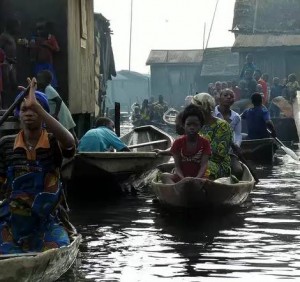
Makoko in Lagos
As we celebrate Earth Day in Costa Rica, take a moment to think about our capital city.
The next time you find yourself in downtown San Jose in the midst of rush hour, say about 5:50 pm on a Tuesday, take a stroll towards the bus stops that take commuters to the southern suburbs of Hatillo and Desamparados. Better yet, head over to the bus terminals of the old Coca Cola market and survey the chaotic scene of commuters, shoppers, street peddlers, panhandlers, winos, taxis, garbage trucks, and other essential elements of bedlam.
While you are taking in the sights and sounds of the busiest areas in Costa Rica, think about all the problems associated with populous cities: crime, noise, pollution, poverty, traffic jams, unemployment, unreasonably priced housing, etc.
Now close your eyes and multiply the extreme sights, sounds and problems in San Jose by a million. By doing so you should have an approximation of what a day in Lagos, Nigeria -the ultimate megacity- can be like.
Think about the inequality that is so evident in San Jose; for example, the stark contrast of the gated hilltop residences in Escazu and Santa Ana -some guarded by armed sentries- against the slums of La Carpio near the city’s sanitary landfill. That bears no comparison to the glaring socioeconomic disparity of Lagos, a metropolis so densely populated that massive sprawling slums are actually floating islands that jut out to the city’s lagoon, and the wealthy are called the “helicopter class” after their preferred mode of transportation.
It’s hard to put an accurate number to the population of Lagos. Estimates by Nigerian census officials are around 8 million, but some researchers put that number closer to 20 million, with about 6,000 people arriving each day from across Western Africa. Most denizens in Lagos live in extreme poverty, and yet it is from these fringes and slums that Lagos is emerging as a “model megacity.”
To consider Lagos a model for urban development may seem ludicrous in the 21st century, particularly when you have examples of strict centralized urban planning like Brasilia, Canberra, Chandigarh, Dubai, downtown Panama City, parts of Melbourne, and several suburbs in Florida. Those places are pristine utopias in comparison to Lagos, and they are referred to as being cold, clinical -almost sterile. Lagos is the complete opposite in terms of organic development; its only comparison could be early New York, or present-day Rio de Janeiro, or future Tokyo -but on steroids.
Babatunde Fashola, the Governor of Lagos State, is hailing the pandemonium city in an international public relations campaign as an example of progressive urban development. Preposterous, some may say, when considering a city that produces 6 tons of solid waste per day, has a murder rate of one percent, grows at a rate of 600,000 inhabitants per year, and claims just over $1,000 in average annual per capita income.
Governor Fashola has a couple of deep thinkers who agree with him: Southern California scholar and expert Mark Davis -author of Planet of Slums- and Dutch architect and philosopher Rem Koolhaas, author of Lagos: How It Works.
The amazing aspect of Lagos is not just the accelerating pace at which the city moves; it’s rather the dogged entrepreneurial tenacity of her denizens who refuse to let the jackhammering pace of the city tarnish their dreams of a better life. Here’s an excerpt from a recent article in The Independent (UK) about Lagos:
The Third Mainland Bridge from Makoko is a place where anything and everything can be bought and sold. A quick survey of goods balanced on the heads of passing hawkers shows roasted almonds, spare parts for watches, boiled eggs, plastic sacks, mangoes, body parts from mannequins, the usual CDs and DVDs, razor blades, inner tubes for bicycles, and packets of “Adam’s Desire”(a remedy for “problems with performance”). One lady shelters from the blinding sun with the help of an umbrella fringed with phone cards.
The book stalls that spill out from the bus station corner opposite the old Anglican Cathedral stalls offer their own window into the city’s modus operandi: think big. One tattered volume that stands out is The Book of Successful Swimming Pools. Other titles, alongside the obligatory Audacity of Hope by one Barack Obama, include: Young and Rich, Manage Your Time, The Power of Your Destiny and Turning a Business Around. In fact there are only really two kinds of books among the stacks: religious or materialist self-help volumes.
If the above description sounds similar to the dystopian cities described in the novels of William Gibson, take a look at this recent video produced by Al Jazeera on the mobile entrepreneurs operating in the vast slums of Lagos. Instead of gawking at the marginal living conditions, concentrate on the unflinching African spirit of the people depicted. If you want to know how Lagos works, the answer is contained in the hearts of her denizens.
Happy Earth Day.
A recent article in The Costa Rica Star touched on Nollywood, the booming film industry of Nigeria that is also one of the largest in the world.



