


 SIGN UP FOR OUR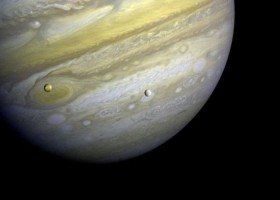
Wikimedia Commons
Washington, May 27 (EFE).– NASA has taken the first step on a mission that will try to determine whether Jupiter’s icy moon, Europa, has the conditions for life.
Nine instruments and sensors have been selected for the spacecraft that will try to determine if a briny ocean is hidden under Europa’s frozen crust and whether temperatures on the mysterious moon would allow some forms of life to exist, the U.S. space agency said.
The agency’s fiscal year 2016 budget request includes $30 million to plan a mission to Europa with a solar-powered spacecraft by 2022.
The still-unnamed spacecraft would go into a long, looping orbit around Jupiter, performing 45 close flybys of Europa over three years at altitudes ranging from 25 kilometers to 2,700 kilometers (16 miles to 1,700 miles).
The instruments selected include a set of cameras and spectrometers to produce high-resolution images of Europa’s surface and determine its chemical composition, as well as that of what appear to be plumes of water shooting from the icy surface, detected in 2012 by the Hubble space telescope.
If the geyser-like plumes’ existence is confirmed – with streams of salt water shooting up to 200 kilometers (130 miles) high – Europa would become one of the best candidates to harbor some type of extraterrestrial life.
NASA’s spacecraft will also be equipped with ice-penetrating radar that will determine the thickness of the moon’s icy shell and search for subsurface lakes similar to those beneath Antarctica.
A magnetometer will measure the strength and direction of Europa’s magnetic field, allowing scientists to determine the depth and salinity of its ocean.
“This is a giant step in our search for oases that could support life in our own celestial backyard,” Curt Niebur, Europa program scientist at NASA Headquarters in Washington, said. “We’re confident that this versatile set of science instruments will produce exciting discoveries on a much-anticipated mission.” EFE



