


 SIGN UP FOR OUR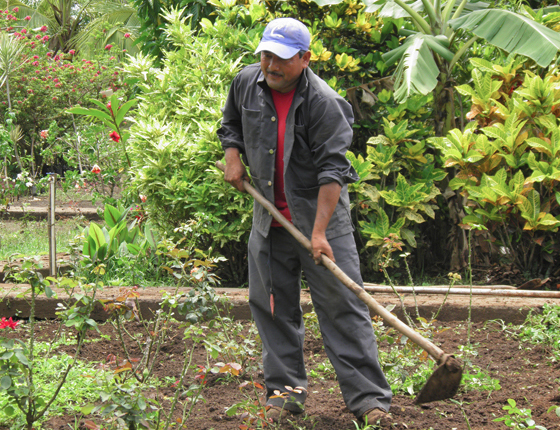
El Rosario, a municipality with a population of 6,500 that’s 32 miles south of the capital of Managua, has a waste system that has become a national model.
The Mayor’s Office of El Rosario teamed with the Center for Social Studies and Promotion (CEPS) in 1998 to form a plan to create an ecological landfill to aid an area that lacks a trash collection system.
The goal was to turn trash into a source of income for the community through the treatment and recycling of waste, and to cut down on water pollution that was being caused by residents’ dumping garbage into streams.
The government spent US$45,000 to purchase land and build the waste management system, but officials also have educated residents on the importance of using garbage to generate money that can spur economic development, El Rosario Mayor Evert López said.
Fourteen years later, El Rosario’s waste management station opened in January 2012 as a botanical garden. The government is urging the community to enjoy the garden’s variety of trees and ornamental plants that are rooted in fertilizer composed of organic waste.
The project’s success has attracted not only local Rosarinos, but also visitors from other cities and countries.
“It looks like a farm more than a garbage dump,” said Nicaraguan tourist Mayerling Mayorga, who visited the garden in June. “There are no foul smells, which makes it difficult to believe that we’re in the middle of garbage. They’ve done a great job because you don’t realize there is trash until you see the workers processing it.”
Visitors can contact city hall and arrange for a free tour of the waste management station, which begins with a lesson in how the techniques used at the station can be applied to visitors’ home gardens.
The waste management station has received visitors and delegations from Brazil, Canada and El Salvador eager to learn how they can replicate the waste management station in their countries, López said.
“[After] 14 years, we’re reaping the fruit of this community effort,” he added. “For us, garbage is not a burden – it’s a source of income, a treasure. The residents of El Rosario are venturing into garbage, as we have no beaches, rivers, volcanoes or any other specific natural attraction that might allow us to draw tourism. Now, we have one: A green trash dump that makes us different.”
Early this year, El Rosario was one of seven Latin American municipalities recognized as an ecological alternative by the Demuca Foundation, which promotes the use of resources in Central America and the Caribbean.
Thirteen families from El Rosario are employed by the project, according to gardener Rafael Ruiz, who works in the waste station.
“This is an effort on the part of all of us who work here,” he added. “We’re proud to have people from across our nation and from other countries visit the landfill because it’s a form of recognition for the efforts we, the workers, are making. I started with this project from the first day, and I hope even more families will find job opportunities when the system is expanded.”
The process starts with city hall employees’ going from residence to residence collecting trash on horse-drawn carts so they won’t emit pollutants.
The waste is hauled to the plant where employees classify it as organic or inorganic, according to Mauricio Gutiérrez, the head of municipal services at the El Rosario City Hall.
The station sells fertilizer created from the 26.1 tons of trash that arrives at the station monthly, Gutiérrez said.
“We’re becoming producers of organic fertilizer. [We also] sell ornamental plants from the nursery that have been treated with our products,” he added. “Now, the waste management system is a treatment plant that gives us the chance to promote the country as a tourist destination.”
About 250 tons received annually at the station is organic waste, which yields two types of organic fertilizer: compost and humus, which sells between US$1.30 and US$3.50 per 220 pounds domestically.
The station produces about 88,184 pounds of fertilizer every three months.
The station also receives about 50 tons annually of inorganic waste, such as metals, low and high-density plastics, glass and aluminum that are sold as scrap.
Proceeds from the sale of waste products allow city hall to recover 45% of the US$3,500 a month it spends on operating the landfill.
“[Thanks to the quality of the fertilizer] we have more than 29 species of ornamental plants and 11 species of fruit and timber-producing trees, which, on top of enhancing the place, are used for commercialization and to reforest the municipality,” Ruiz said.
The El Rosario experiment has encouraged other Nicaraguan cities such as Tipitapa, Nagarote and Masaya to open waste management stations, López said.
“We want to become an example,” he added. “We’ve found an alternative, and we’re training other city governments so they can be successful like we are.”
Source: InfoSurHoy.com



