


 SIGN UP FOR OUR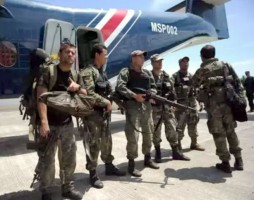
Source: Revista Paquidermo Creative Commons
On the eve of the 100th anniversary of the Panama Canal, a special situation was being scrutinized by intelligence and special operations analysts at the secretive United States Combined Air and Space Operations Center located within Davis-Monthan Air Force Base in Arizona. Master Sergeant Kelly Ogden wrote the following account for the U.S. Defense Video & Imagery Distribution System:
An illegitimate organization seeks to undermine peace, security and liberty by destabilizing local and regional economies in Central America. The organization is trying to disrupt operations and/or take over the Panama Canal, which poses a serious threat to the region.
The canal is critical to global commerce and the U.S. is obligated to defend the neutrality of the canal in times of peace and times of war under the Panama Canal Neutrality Act.
In response to the imminent threat, a multi-national force knows as Multi-National Force-South (MNF-S) has stood-up to support Operation Sea Stallion. MNF-S consists of naval, air, and ground assets from several countries from the region and across the globe.
Thankfully, the above report by Master Sgt. Ogden was only an exercise, a simulacrum for special operations elements of several nations from North America, Central America, the Caribbean, and South America. It was part of PANAMAX 2014, an annual training event coordinated by the U.S. Southern Command. The exercise illustrates the importance of the Panama Canal for the global shipping industry, and it calls up the possibility of responding to potential threats with special forces.
Although Costa Rica does not have an army by virtue of constitutional abolition, three officers from the National Coast Guard Service and the Chief of Public Relations of the Ministry of Public Safety (Spanish initials: MSP) in Costa Rica participated in PANAMAX 2014. Perhaps Costa Rica could have contributed a detachment of police officers from the elite Special Intervention Unit (Spanish initials: UEI), but perhaps they wanted to rest the seven men who participated in Fuerzas Comando 2014 in Colombia, where Costa Rica finished within the top 10.
In 2012, The Costa Rica Star reported at length on Fuerzas Comando, which has been called the “military Olympics of the Americas.”
a special detachment of Fuerza Publica officers from Costa Rica participated in the Fuerzas Comando 2012 competition in Colombia, a militaristic tournament organized and sponsored by the United States Southern Command (SOUTHCOM) -the military Unified Combatant Command from the U.S. Department of Defense (DoD) that is responsible for providing contingency planning and operations in Central and South America, as well as the Caribbean.
Here’s a description of this year’s event by the U.S. Department of Defense:
After a week of intense heat and extreme competition, Fuerzas Comando, the annual U.S. Southern Command-sponsored special operations skills competition, came to an end July 31 with a closing ceremony at Fort Tolemaida, Colombia.
Seventeen nations competed to earn the title of best special operations forces team in the Western Hemisphere.
Despite not having military forces, Costa Rica has actually won the Fuerzas Comando war games once in the past. The county’s participation in this exercise has been highly criticized before, but spokespersons from the MSP have gone on the defense to explain that there is much that the UEI can learn from Fuerzas Comando. Another explanation often given is that Costa Rica needs a highly-trained UEI in the wake of situations such as the “Google Maps Invasion” of Isla Calero by Nicaraguan soldiers a few years ago. A counterargument is that the Calero affair has already prompted the creation of a Border Police unit within Fuerza Publica, and these police officers are being trained in military tactics right here in Costa Rica.
In the case of PANAMAX 2014, Costa Rica’s participation is very limited, and not a single UEI officer participated. At the same time the exercise unfolded in the Panama Canal, protesters near Fort Benning in Georgia were planning the 25th annual demonstration against the controversial School of the Americas (SOA), a special training post operated by the U.S. military that has been around since 1984. SOA specializes in training Latin American military forces under the auspice of the Western Hemisphere Institute for Security Cooperation. MSP personnel from Costa Rica have attended and graduated from SOA despite heavy criticism from the public. The reason SOA has attracted protesters for the last 25 years was recently reported by Ben Wright of the Columbus Ledger-Enquirer:
SOA Watch protesters from across the United States and the western hemisphere have gathered at the main gate since the first anniversary of the 1989 massacre of a 16-year-old girl, her mother and six Jesuit priests at the University of Central America in El Salvador. The group has claimed that graduates of the School of the Americas were linked to the slayings.
What many people fear about Costa Rica’s involvement in events such as Fuerzas Comando and PANAMAX is that militarization could continue to grow into a state of affairs similar to Panama, a country that has also abolished its armed forces but receives millions of dollars in military equipment, weapons and training from the U.S. each year. During a recent interview by Manuel Sancho of Costa Rica Hoy, MSP communications coordinator Boris Ramirez stated that Costa Rica and Puerto Rico were the only participants in Fuerzas Comando that send police forces rather than soldiers. Notice how Mr. Ramirez did not include Panama in his statement.
In the end, Costa Rica would not like to see what recently unfolded in Ferguson, Missouri, because it confirms the fears of militarizing police forces. Stephen Downing, former Deputy Chief of the Los Angeles Police Department, recently summarized the issue in an article for the Huffington Post:
The militarization of local law enforcement was seeded by the Nixon administration’s declaration of the war on drugs in the early 1970s, and took root in the 1980s as result of President Reagan’s escalation that poured millions into the drug war, shifting the focus of local law enforcement away from violent and property crimes to mostly small-time drug offenders.
The military mission is to confront and kill a defined enemy. The peace officer has no enemies. His or her mission is to protect the community and everyone within it. No matter what crime they may have committed, all are entitled to [certain civil] protections […]



