


 SIGN UP FOR OUR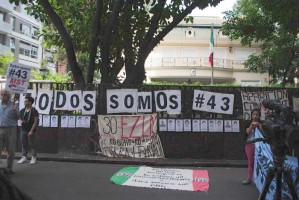
Wikimedia Commons
Aboard the papal aircraft, Feb 18 (EFE).– Pope Francis said Thursday that he did not meet with relatives of 43 trainee teachers kidnapped 18 months ago in southern Mexico because he had received multiple requests from different groups, “including ones at odds with one another.”
The Argentine pontiff made the remarks to international media, including EFE, while flying back to Rome from the northern border city of Ciudad Juarez, the last stop of his five-day visit to Mexico.
“There were a lot of groups, including ones at odds with one another and with some internal struggles,” Francis said, adding that “I told them I would see all of them at one of the Masses.”
He also said that during his visit to Mexico he made “constant reference to the killings, the lives claimed by gangs of drug traffickers and people traffickers, to the violence as one of the wounds Mexico has suffered.”
The parents of the 43 abducted trainee teachers, however, denied Thursday that they had any problems with other associations of families of missing persons.
“We categorically deny that there is any conflict with the others. On the contrary, they have shown a lot of solidarity with us,” the attorney representing the families, Vidulfo Rosales, told EFE.
He added that although the processes and dynamics are different and “they began their struggle earlier,” “there’s no difference at all. The desire is the same, for the Mexican state to present them alive and for the search to be conducted effectively.”
Mexico has been racked by deadly turf battles among powerful drug gangs for the past decade, while international human rights groups, including Amnesty International and Human Rights Watch, say members of the security forces carry out disappearances and sometimes collaborate directly with criminal groups.
Rosales told EFE on Monday that an invitation for three of the relatives of the missing 43 to attend Pope Francis’ Mass in the northern border city of Ciudad Juarez would be declined.
He said his clients delivered a letter to the pontiff on Saturday – the first full day of his visit to the Aztec nation – and had hoped that “the pope would make some specific comment about the problem faced by the 43” and by thousands of other missing people in Mexico.
Forty-three trainee teachers enrolled at the all-male Ayotzinapa Rural Normal School, which has a history of left-wing activism, were abducted in Iguala, a town in the southern state of Guerrero, on Sept. 26, 2014.
The students, according to the official account, were grabbed by corrupt municipal cops after they had commandeered buses they planned to use in a protest in Mexico City.
They were subsequently handed over to drug-cartel gunmen who killed the youths and burned their bodies at a dump, the government said early last year, describing that version as the “historical truth.”
But the parents of the missing students and their supporters reject the incineration scenario, and in September 2015 a group of independent experts commissioned by the Inter-American Commission on Human Rights said in a report that “no evidence existed” to support the government’s theory that the bodies had been burned at the dump outside the small town of Cocula.
The experts also corroborated news reports indicating that Federal Police had been monitoring the students since they left Ayotzinapa for Iguala and at the very least knew that they had come under armed attack yet did not intervene.
In their missive to Pope Francis, the Ayotzinapa parents decried “corruption in the security forces” and “the obstruction of justice” by authorities who have clung to a theory of the crime that has been discredited by internationally recognized experts in forensics, Rosales said.
Acknowledging he lacked “certain knowledge” of the matter, the attorney cited indications that “Mexican diplomacy has been working for months to avoid a meeting of the pope with the parents.”
The Ayotzinapa families are engaged in a struggle against Mexico’s institutions “and it would be very risky for the state if the parents have the support of the pope,” Rosales said. EFE



