


 SIGN UP FOR OUR
Click image to enlarge

Editor’s note: The views expressed by guest columnists are not necessarily those of The Costa Rica Star, its advertisers, or its staff.
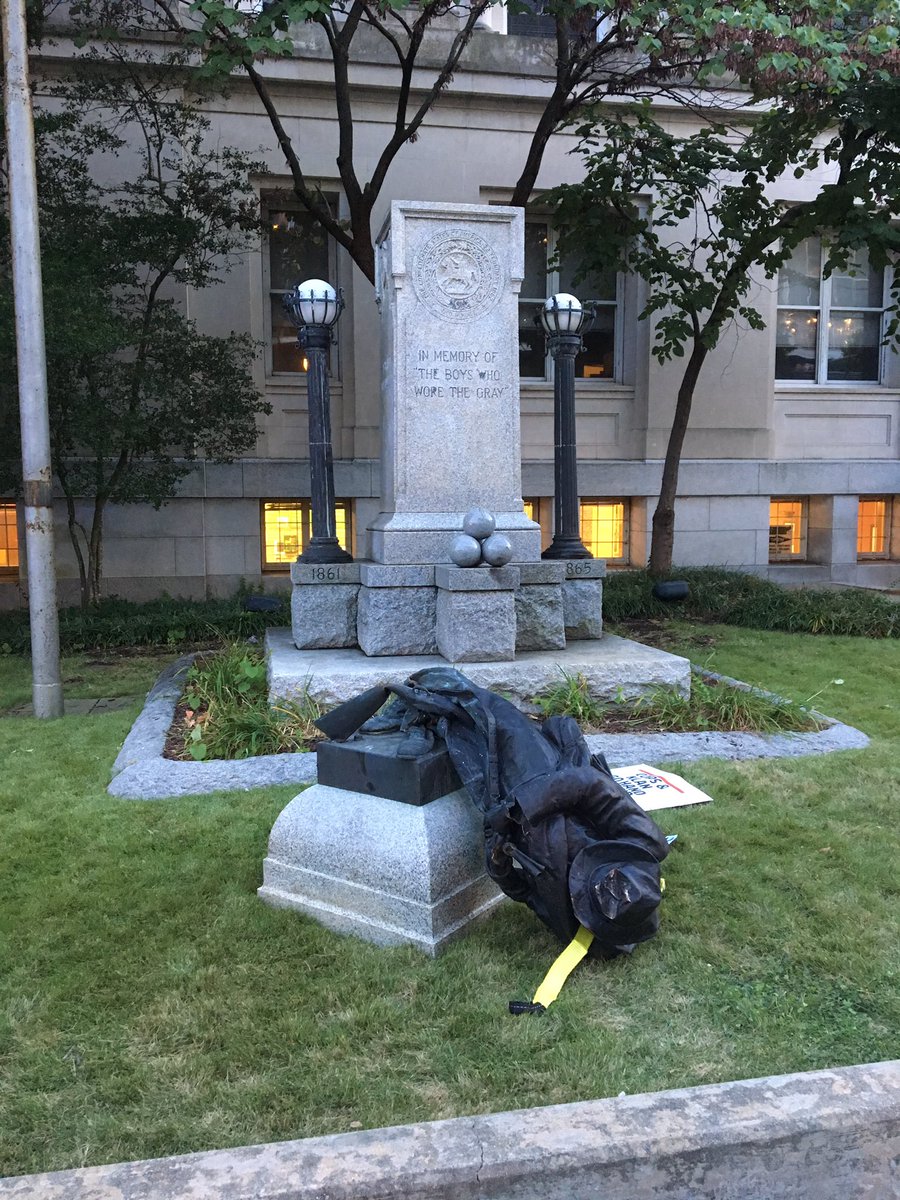
The impromptu take down of a Confederate monument Monday night in downtown Durham, North Carolina, without any police stepping in to stop the destruction shows just how scared local law enforcement is of racial confrontations.
What happened Saturday in Charlottesville, Virginia — a two-sided protest involving the removal of a Civil War statue of Confederate Gen. Robert E. Lee on his horse erected in 1904 — led to the deaths of a woman and two Virginia State Troopers when their helicopter crashed just outside this historical city as they hovered above observing the violence.
Two days later what happened in Charlottesville spilled over into Durham.
More than 100 protesters – mostly black and white youth– took to the streets of Durham shortly before dark, threw a rope around a Confederate-era statue and pulled it off its pedestal. The incident was broadcast live to the nation, and was video-taped by the Durham County sheriff’s office who did nothing to stop the vandalism of public property. Arrests of those who damaged the Durham monument began Wednesday morning, news reports said.
The Durham County courthouse – where this monument has stood since 1924 – is under the jurisdiction of the Durham County sheriff’s office and not the Durham police department, according to news reports.
There are about 1,500 confederate bronze and granite Civil War memorials located in 31 states, mostly in the southern United States, but there are some in northern states as well, according to the Southern Poverty Law Center. They were built and erected in the early 1900s to remember more than 600,000 lives lost during the U.S. Civil War. They are not monuments to black slavery – they never were.
Many public schools in southern states are named after Civil War Confederate soldiers and generals such as J.E.B. Stuart High School in Falls Church, Va., where the local Fairfax County school board voted recently to change the name of the school to just Stuart High School, as if that was some kind of historical compromise. This name change caused generations of former Stuart alumni to lose a bit of their own history.
There are 10 U.S. Army bases named for Confederate Civil War officers stretching from Texas to Virginia and, according to news reports, the Pentagon has no plans for any name changes to Fort Benning, GA., Fort Bragg, NC., and Fort Hood, TX. – or the seven others.
These Confederate monuments have indeed become a symbol – however misguided – of racist America in an era of rabid political correctness. In the current left-wing-liberal mindset these monuments no longer represent the real history of the U.S. and the Civil War, the most costly of wars in terms of lives lost on both sides. The nation became one nation after the Civil War, but that was then – not now.
After the deadly events in Charlottesville, President Donald Trump spoke out against the violence and expressed a heartfelt sympathy for the Charlottesville victims. He promised justice for them and prosecution of the deranged man who drove a car into a crowd on a city street killing one and wounding 19 others.
The anti-Trump forces immediately pounced on the president denouncing his words as promoting racism and bigotry in America. The president again on Monday more specifically denounced the racist violence of the KKK, white supremacists and neo-Nazi groups, but still the president’s words were not enough to quell the anger coming from mainstream media, the Democrats and the president’s detractors that are now claiming the deaths in Charlottesville are directly President Trump’s fault.
There is little unity in the U.S. right now – except for those that oppose or support President Trump. The racial divide is wide as ever – that’s what gets the attention now — all over mainstream media whose obsession with Trump campaign and Russian collusion stories appears to be over.
To stand up for President Trump puts you on everybody else’s blacklist that doesn’t like this president who is attempting to change this America in radical, more economic ways without the far-reaching influences of special interests. Even tabloid news is abuzz with stories about celebrity movie stars, musicians and artists that support President Trump are being sidelined and blacklisted by establishment Hollywood in their dislike of President Trump.
Following the president’s words on Monday, made from the White House, he returned to his home at Trump Tower in New York City. Greeting him were thousands of loud anti-Trump protesters chanting and carrying signs on the street along with heavy police presence, high security and intense-live-media coverage. Why did the president go to Trump Tower? The White House including the Oval Office and family quarters are undergoing renovations which leaves President Trump and family basically homeless except for the presidential retreat Camp David, his New York City penthouse and homes at his luxury golf resorts in New Jersey and Florida. No doubt the president saw these protesters and their level of hatred.
The fight over these Confederate monuments is far from over. Many communities — just like Charlottesville and Durham — are facing a growing movement to have them removed from public places such as county court houses and city parks. But what will happen to these truly historical artifacts that never were intended to be divisive? Perhaps they should be taken to places like Stone Mountain, Ga., the site of the largest ‘bas-relief’ rock sculpture in the world depicting Confederate President Jefferson Davis and Generals Robert E. Lee and Stonewall Jackson — all three on horsebacks. It’s bigger than Mount Rushmore and it’s owned by the state of Georgia. Some could be moved to Civil War battlefield sites like Gettysburg, Pa. What better places would there be to reassemble these relics of the past and retain their history.
This historical amnesia over these Confederate monuments should never have developed in the first place, but it has and it’s surreal.
About the Author
Britt Nelson relocated to Costa Rica in 2011 from Florida, where he served as news editor for the Palatka Daily News, a newspaper owned by the New York Times Regional Newspaper Group (NYT-RNG) for 20 years.
Nelson served the NYT-RNG for 18 years in Tennessee, Kentucky, Virginia, North Carolina and Florida as a correspondent, reporter, staff writer, senior staff writer training new reporters, copy editor, page designer, editorial writer, editorial page editor and editorial board member.



