


 SIGN UP FOR OUR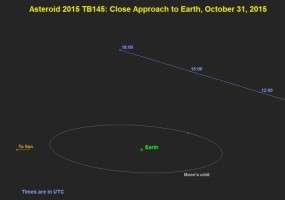
Source: NASA
Washington, Oct 31 (EFE).- On Halloween night a large asteroid, dubbed “The Great Pumpkin” and measuring the size of four soccer fields, came near Earth, and scientists around the world prepared to witness this unusual phenomenon that occurs only once every 10 years.
It looks like a point of light, according to Paul Chodas, director of the NASA’s Near Earth Object office at the Jet Propulsion Laboratory (JPL) in Pasadena, California, adding that the human eye will not be able to see it and advises the use of a small telescope to see this very brilliant celestial body.
At 1701 GMT this Saturday, the space rock, technically identified as 2015 TB145, was about 480,000 kilometers (298,000 miles) miles from Earth, which means the asteroid flew a little farther away than the moon, according to estimates of the National Aeronautics and Space Agency, or NASA.
TB145 has a diameter of some 400 meters (1,300 feet) and brushed past Earth’s orbit at some 126,000 kph (76,000 mph), which did not pose a threat to the planet.
The fact that just two weeks ago the existence of the “Great Pumpkin was unknown, yet today it will pass so close to Earth, shows that “we are very vulnerable,” according to one of the Spanish astronomers following its progress.
For astronomer Miquel Serra, a member of the solar system research group of the Astrophysics Institute of the Canaries, or IAC, it is “incredible” that a celestial body like this, almost a kilometer (2/3 of a mile) in diameter, should be discovered only two weeks ago.
For his part, IAC astronomer Javier Licandro noted that a collision with a celestial body measuring slightly more than 30 meters (98 feet) in diameter could cause a catastrophe, while one that is more than 1 kilometer (2/3 of a mile) in diameter would come close to wiping out life on Earth.
Licandro also said that it is very important to follow the path of 2015 TB145 because it is quite large and within centuries could collide with Earth. EFE



