


 SIGN UP FOR OUR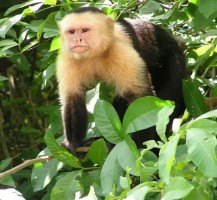
Source: Wikimedia Commons
Earlier this week, the Animal Planet cable television network premiered a new, two-hour documentary focusing on primate intelligence, particularly among the simian species. This engrossing TV program, which travels to Borneo, Thailand and Costa Rica, shows us how apes are smarter than we think, and that humans still have a lot to learn from our fellow species. Let’s put it this way: The monkeys we keep captive for behavioral research learn from us than we learn from them.
The large human brain gives humans the evolutionary edge over all other species, but studies show that almost everything we have learned has been handed down from our primal ancestors. In THE REAL APES OF THE PLANET, Animal Planet travels around the globe for an unprecedented look at some of the various 400 specimens that make up the primate family and the surprising way our behavior mirrors theirs. The new two-hour documentary THE REAL APES OF THE PLANET aired on Tuesday, October 21, at 8:00 P.M. ET/PT in North America. The special will air on Discovery Channel and Science Channel at a later date.
THE REAL APES OF THE PLANET explores the surprising and mind-blowing similarities that humans share with our fascinating primate cousins. Passing on family traditions and grooming practices as well as ingenious survival tactics and the primates’ ability to solve complex problems and form communities with a hierarchy system, the special highlights devoted parenting to fun-loving kids. Viewers also witness how, akin to humans, apes may demonstrate deceitful behavior to get what they want, overindulge in life’s pleasures and not always get along.
With their highly intelligent minds, chimpanzees in Uganda demonstrate their problem- solving skills and tool use when posed with a honey challenge. The long-tailed macaques in Thailand find a clever way to floss after a meal, and an orangutan in Borneo maintains her personal hygiene with a little soap and water. In Iowa, a male bonobo named Kanzi picks his own food for a picnic; he uses lexigram and toasts marshmallows in a fire he makes himself while the white-faced capuchins in the rain forest of Costa Rica uncover the secret that the sap of the Guyabano (guanábana or sour sop) tree acts as a mosquito repellent if rubbed on their fur. THE REAL APES OF THE PLANET uncovers how these animals are individuals with their own personalities and why brainpower is essential to primate survival.
According to the International Union for Conservation of Nature (IUCN), the primate taxonomy of Costa Rica features eight monkey species, which we know as two titís (squirrel monkeys), three spider, one howling, and the cariblancos (white-faced capuchins that appear on our 5,000 colones bill). The Aotus zonalis nocturnal monkey is a night stalker that is difficult to spot in the wild, and it is believed to migrate unseen from Panama into Costa Rica.



