


 SIGN UP FOR OUR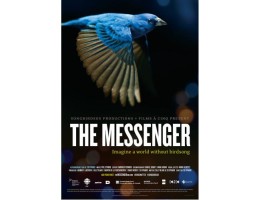
BirdSongSOS.com
Imagine a world without birdsong.
Su Rynard’s wide-ranging and contemplative documentary THE MESSENGER explores our deep-seated connection to birds and warns that the uncertain fate of songbirds might mirror our own. Moving from the northern reaches of the Boreal Forest to the base of Mount Ararat in Turkey and from the streets of New York to the coffee farms of Costa Rica, THE MESSENGER brings us face-to-face with a remarkable variety of human-made perils that have devastated thrushes, warblers, orioles, tanagers, grosbeaks and many other airborne music-makers.
On one level, THE MESSENGER is an engaging, visually stunning, three-act emotional journey, one that mixes its elegiac message with hopeful notes and unique glances into the influence of songbirds on our own expressions of the soul. On another level, THE MESSENGER is the artful story about the mass depletion of songbirds on multiple continents, and about those who are working to turn the tide. In the words of Boreal biologist Erin Bayne, “Could we live without birds? We don’t really know for sure… That’s one of the fundamental concerns when you play with nature, pull one piece out, and maybe that’s a pivotal piece, we just don’t know.”
Technical Aspects Filming Songbirds in Costa Rica
“Filming wildlife, tiny songbirds included, takes a special set of technical skills, nature-knowledge, and patience,” explains cinematographer Joshua See:
From the camera technical side of things you typically need large telephoto lenses and big stable tripods that support the camera’s weight and keep shots steady. You’ll also need strong legs to haul the gear to where the wildlife is!
While filming on location in Costa Rica more often than not I was able to identify busy bird locations where he could set up inconspicuously and wait. Flowering trees, ripe banana plants, or a shady trickling stream were bird hotspots.
Our incredible bird guide, Ernesto Carman from Café Christina coffee farm, took director Su Rynard and me to a large and beautiful tree next to an old café in a Costa Rican river valley. There, every night hundreds of Baltimore orioles and Rose-breasted Grosbeaks seek refuge under its canopy. We watched and filmed in amazement as streams of beautiful birds converged on the old tree.
Songbird Conservation in Costa Rica
One important songbird conservation topic underscored by THE MESSENGER is the risk of monoculture farming. To this effect, the film crew was supported by Alejandra Martínez-Salinas, an ecologist/ornithologist and a PhD candidate in the Joint Doctoral Program between the University of Idaho and CATIE, the Tropical Agricultural Research and Higher Education Center (CATIE) in Turrialba.
When she was still in college in her native country of Nicaragua, Alejandra had the opportunity to assist a group of ornithologists from the Smithsonian Institute doing field work. Back then, she only learned how to set up and take down mist nets just prior to going into the field, and she didn’t have much experience releasing birds from the nets. Today, fifteen years later, Alejandra leads the Bird Monitoring Program at CATIE.
Our crew filmed a wonderful scene with Alejandra handling a Mourning Warbler, which had come back to CATIE after being banded in the same site the year before. Most common migratory songbird species visiting their mist nets are the Yellow and Chestnut-sided Warblers, Northern Waterthrush, Mourning and Tennessee Warblers, Alder Flycatcher and Swainson’s Thrush. Some of the rare or one-time visitors include Blue-winged and Golden-winged Warblers, Bay-breasted and Blackpoll Warblers.
Alejandra is very concerned about how monoculture farming is affecting diversity and habitat on coffee farms. She is currently conducting experiments to prove that birds can have a significant effect on reducing harmful insects, like the crop damaging coffee berry borer. She says if they can convince the local farmers that the birds can do just as good a job as chemical pesticides, it will be really good for the birds, because more farmers will want to have more diverse crops to attract more birds to their farms, and the farmers will in turn save money on pesticides. Reducing pesticides benefits the whole ecosystem in many ways.
UPCOMING CANADIAN SCREENINGS FOR THE MESSENGER
Theatrical Premiere – Friday February 26
February 26 – March 3, 2016 Carlton Cinema
Toronto, ON CANADA
Showing at 1:30pm and 6:45 daily.
Opening night premiere sponsored by First Weekend Club
Q & A with filmmaker Su Rynard following the film.
February 26 – March 3, 2016 The Loft
Cobourg, ON CANADA
Showtimes TBC
Q & A with filmmaker Su Rynard Sunday February 28.



