


 SIGN UP FOR OUR
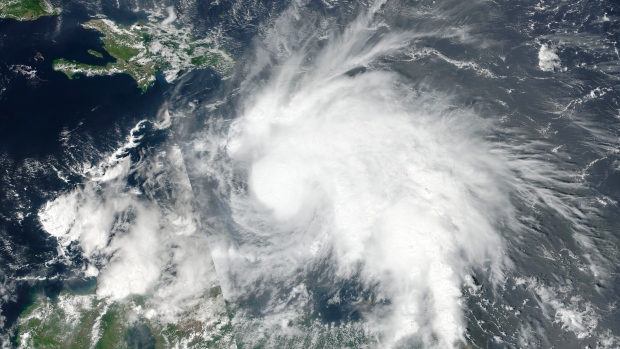
It’s no coincidence that Costa Rica’s rainiest months are August-October, with these corresponding to the Atlantic hurricane season, whose influence can often spread throughout the country.
Right now on the horizon is Tropical Storm Harvey, making its way steadily westward. Forecasters are uncertain whether the system will gain or diminish strength over the weekend as it enters the Caribbean.
Its predicted path shows it passing over Nicaragua’s north Caribbean coast, but depending on the size of the storm and its eventual path, Costa Rica’s Caribbean coast could feel the effects starting around Sunday evening.
Will the storm coincide with Monday’s solar eclipse? Meteorologists are bracing for a possible very rare coincidence of natural events, according to reports on the Weather Channel (weather.com).
At this “climatological peak of the hurricane season … each tropical wave or area of low pressure in the Atlantic Basin must be watched closely for development,” said forecasters at Weather.com, “Named storms can form in about every part of the Atlantic Basin this time of year.”
For example, forecasters tracked the recent disturbance that formed into Gert to the northeast of the Bahamas last weekend for 10 days before they saw it develop into a storm. The Atlantic storm initiated as a tropical wave over Africa.
Right now there is a third such wave rolling off Africa’s west coast, which meteorologists say could also become a cyclone as it heads west about 15 mph, due to its characteristics.
The middle of August is generally the start of an uptick in the number of Caribbean storms, with the region’s hurricane season peaking around Sept. 10, said scientists at Weather.com.
While not all tropical waves or low-pressure systems that emerge from Africa become tropical depressions or tropical storms, they are all monitored closely, especially when atmospheric conditions are ripe for them to develop and grow, said forecasters at Weather.com.



