


 SIGN UP FOR OUR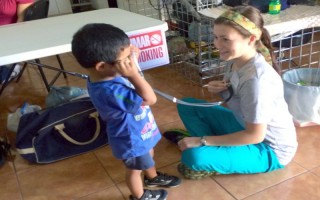
Source: PSU
The following press release was originally published by News Services department of Plymouth State University in New Hampshire.
PLYMOUTH, N.H. – A dozen Plymouth State University student nurses spent the first 10 days of the new year in Costa Rica, home of some of the world’s most pristine rain forests and beaches. But these students weren’t on vacation; in fact, they were hard at work in some of the toughest imaginable conditions providing badly needed health care to the country’s most impoverished citizens.
“I don’t think any of the students had ever seen that level of poverty, the despair of their living conditions,” said Sandra McBournie ’06G, a clinical assistant professor who was one of the faculty advisors accompanying the students. “This was a transformational learning experience for them.”
The trip was the clinical element of the Global Health course, a requirement of the Plymouth State University nursing program. The 65 hours of hands-on experience allowed students to apply classroom theory to the practice of nursing in a developing country, according to Ann-Marie Cote, clinical assistant professor and trip advisor.
“Diseases like Ebola come from developing countries and our nursing students need to be prepared for that reality; you can read about it, but actually seeing it is critically important,” said Cote. “Many of the houses are corrugated metal shacks, with bars and razor wire surrounding them. There are beautiful beaches and breathtaking scenery and wildlife, but we spent most of our time in very run-down sections of the country. We were busy from morning to night.”
“This is part of our responsibility as a first-world country,” added McBournie. “The students were treating chronic conditions like diabetes, emphysema, hypertension and things we don’t see here, like parasitic infections, fungal infections and dust and dirt related diseases. It was an incredibly valuable experience for them—global health is a movement PSU believes in. In so many aspects, the world is getting smaller.”
Costa Rica is a Central American country located just north of the equator and is about the size of Vermont and New Hampshire combined. The trip was arranged through the educational organization International Service Learning (ISL), which partners nursing students and medical professionals from developed countries with service opportunities in developing countries. Although it has a robust economy and effective medical system by Central American standards, health care is still largely unavailable to those without a job.
“If you don’t have health insurance through employment, it’s difficult to see a doctor,” McBournie said. “You’ll be turned away at a hospital unless you have a life-threatening illness, or if you’re a child or a pregnant woman. You can’t take getting medical care for granted there. There is no such thing as Medicaid or Medicare.” [Note by The Costa Rica Star: There are similar programs at the community level.]
“It was a huge culture shock for us because in the United States, we treat first, pay later, and in Costa Rica it’s much different,” noted PSU nursing student Katlyn Piscatelli ’15. “We diagnosed simple problems like arthritis and impetigo that can be easily treated in the U.S., but in Costa Rica, can go undiagnosed for months or years. This experience was eye opening and I cannot put into words how valuable it was for my career.”
The most challenging part of the trip, according to Cote, was travelling to remote villages, which could take hours in stifling heat.
“Costa Rica’s roads are not good, making travel and long bus rides uncomfortable,” Cote said. “You really rely on the bus drivers to get you from place to place.”
Nursing student Victoria Weltlich ’15 said travelling to a foreign country to improve her skills was a great opportunity.
“I was able to learn on such a broad scale about health care availability, adapting to limited resources, overcoming language barriers and so much more,” Weltlich said. “Treating patients who didn’t speak English was initially a challenge for me, but as I became more comfortable with the culture and the language I was able to connect more easily. It made me proud to be a nurse providing care to those who truly needed and appreciated it.”
Cote said the students are forever changed by their trip.
“I saw enormous growth in their nursing assessment skills and in their self-confidence in working with patients. They knew there was a difference between Plymouth, New Hampshire, and Central America, but now they know the issues firsthand.”



