


 SIGN UP FOR OUR

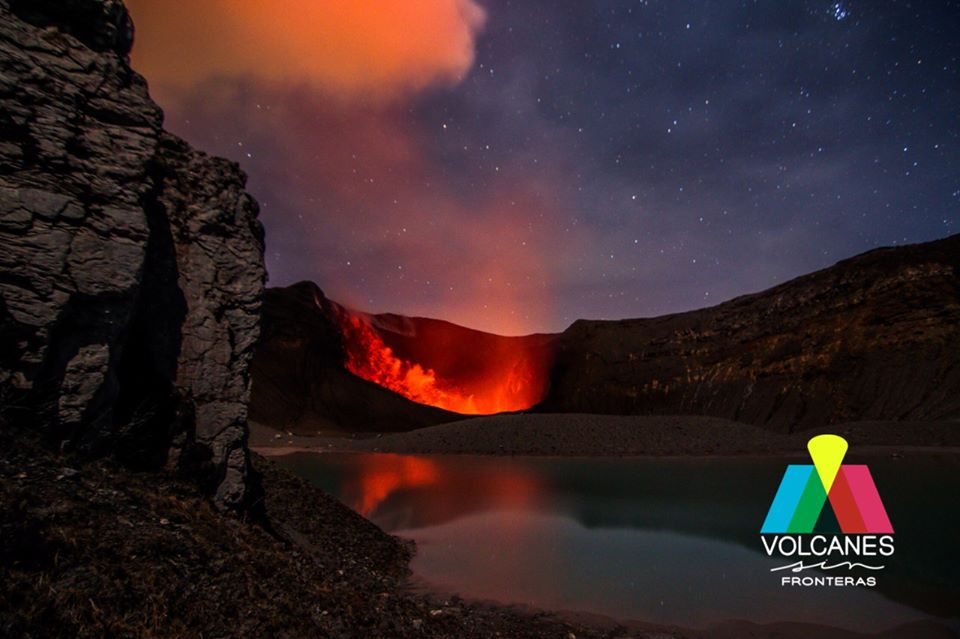

Photo Credit: Cusuko fotografía and Iván Meza Photography, members of Volcanes Sin Fronteras-VSF.
Volcanes sin Fronteras (Volcanoes without Borders) a non-governmental organization in Costa Rica dedicated to the study of volcanoes shared impressive images of the Turrialba Volcano in Costa Rica and its constant activity.
The video and the corresponding report regarding the findings by the vulcanologists follow:
“We visited the peak of the Turrialba Volcano between the month of December 2017 and the first two weeks of January 2018 to work on taking samples of ash expelled recently and carry out measurements of the activity of the active crater.
The activity is dominated by an intense degasification of the active crater, with sporadic explosions every 30 minutes to an hour. During this emanations, particles of ashes are released that reach heights of more than 300 meters above the crater. In the field we can clearly see a series of phreatic volcanic deposits, phreatomagmatic –strombolianic (eruptions resulting from interaction between water and magma and mildly explosive), generated since October 2014 and to date.
In our visits we observed several explosions of superficial origin, through a camera installed on a dron.
This is possibly a result of the accumulation of gas that causes an increase in the pressure close to the surface and generates constant eruptions. Samples were taken to run analysis in the stereoscope and the scanning electron microscope (SEM) of the National Laboratory of Nanotechnology (Lanotec-CeNAT). In these we can confirm the heterogeneity of the shapes and forms, as well as the type of fragment. In these eruptive events non juvenile fragments were expelled in at least a 95% and magma or juvenile fragments in a 5%.
Incandescence:
Using the drone, we could observe, at a depth of close to 250 meters from the Southeast edge of the active crater, incandescence, in at least four points with diameters in average of 3 meters; this can be explained in two ways:
- 1. Fumaroles at a very high temperature (≥600 °C // 1112⁰F). This has been observed in previous years in the Turrialba and Poas Volcanoes.
- 2. Visible magma in the conducts or volcanic cracks, close to the surface.
In volcanology terms we can say that the Turrialba Volcano is an open vent system, where the activity is dominated by a magmatic system. In addition the strong heat and pressure is close to the surface which could generate eruptions of bigger size in a short term. We consider the second to be the strongest hypothesis.
We consider it is necessary to follow up on the activity through drone recordings, thermal camera and ash sampling, to explain with precision what is happening currently. It is possible that stronger explosions than those registered recently take place. It is worth to mention that the Turrialba volcano has been generating eruptions for 8 years, after a period of calm of 146 years.”



