


 SIGN UP FOR OUR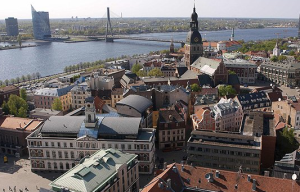
Skyline of the Latvian capital Riga
In the 20th century, economists and analysts in the United States convinced the government to adopt the per capita gross domestic product (GDP) measurement as the main yardstick of its economy. Just about every nation followed suit, which is why we are now able to compare Costa Rica with other countries and regions in terms of GDP. It turns out, however, that Costa Rica’s low GDP falls short of explaining the country in some aspects.
GDP can be described as the act of measuring the total market value of goods and services produced by a nation each year. GDP calculations can be further augmented by the purchasing power parity index (PPP), which many economists believe is a more adequate means of assessing the real value of a national economy. PPP is often used for colorful estimations such as the Economist’s Big Mac Index and Costa Rica’s own casado index.
GDP and PPP statistics are often used to compare sovereign economies. For example, we know that the State of California has a similar GDP and PPP as that of Germany, and that the tiny European country of Luxembourg has an amazing GDP and PPP of $103,125 -more than Canada and the United States added together! Not everyone agrees on GDP and PPP as the end-all and be-all measurement of a national economy, but its close correlation with the United Nation’s Human Development Index (HDI) has made it an oft-cited statistic.
Costa Rica’s GDP and PPP of $12,800 in 2012 was estimated by the International Monetary Fund (IMF) as being the 84th largest in the world. This means that countries such as Serbia, Lebanon, Bulgaria, and even Sudan had a higher industrial output than Costa Rica. Even the GDP and PPP in states such as Mississippi and Vermont in the U.S., are double Costa Rica’s production.
Judging Costa Rica purely by her GDP in the Americas would invite comparing her to Caribbean nations such as Cuba, the Dominican Republic and Jamaica. However, Costa Rica is a bit of an anomaly insofar as her GDP belies her standing in relation to environmental performance and social progress. The Yale and Columbia Universities’ Environmental Performance Index placed Costa Rica as the fifth greenest country in the world (Portuguese) along with GDP giants such as Switzerland, Norway, France, and Austria. In terms of social progress and access to basic human needs (Spanish), Costa Rica ranks higher than the BRICS nations with the exception of Russia.
Given the country well-being indices cited above, there is one nation that offers closer comparisons to Costa Rica: Latvia. This low-GDP member of the European Union has a higher environmental record than Costa Rica, which ecotourists are beginning to discover. Latvia also fared better than many other nations in terms of fending off the throes of the global financial crisis after 2008, and her social development record in the 21st century has been praised by observers. In the end, Costa Rica and Latvia are examples of nations where life can be pretty good despite low GDP statistics.



