


 SIGN UP FOR OUR
 By Wendy Anders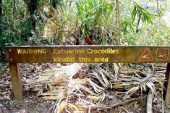
With tourism generating $2.8 billion in revenue last year, according to the Costa Rican Tourism Board (ICT), and employing more than 1/2 a million Costa Ricans either directly or indirectly, crocodile attacks on tourist beaches are an issue of national concern.
That’s why the Tamarindo Integral Development Association (ADIT) has been meeting intensively with a host of local agencies and residents to discuss ways to prevent future crocodile attacks like the one that occurred a week ago when a surfer was attacked, and subsequently lost his right foot, while crossing the estuary connecting Tamarindo beach with Playa Grande.
That same day, two additional signs warning about the presence of crocodiles were put up by ADIT in coordination with the Environment and Energy Ministry (MINAE). But the Tamarindo Integral Development Association (ADIT) felt more needed to be done.
Relocating or killing the animal/s are not considered options, stated the residents’ group, saying “many of us took the decision to move to this beautiful place, one reason being its wonderful nature and wildlife. The crocodiles, sharks, snakes, etc. were here before us, this is where they belong, and we have to find a way to peacefully live together or close to each other.”
The association is working with the Las Baulas National Park administration to define where an additional 10 signs will be located and to secure funds for the signs. They want to try to engineer one of the signs to float in the estuary.
A more direct solution is to offer safe ways for visitors to cross the estuary, said ADIT. The group is considering a plan to offering reliable, daily boat transfers to “give tourists and locals an alternative to paddling or swimming through the river … the transfers would have to start early in the morning and stop at sunset,” said the association in a public statement yesterday.
Association members echoed concerns that have been raised by conservationists in recent years about the potential impact of tours that involve feeding and regular close contact with crocodiles. Whereas before cros might have tended to avoid humans, they claim, ADIT and others allege the animals now perceive humans as a source of food which has primed them to attack. This widespread theory that has not yet been scientifically studied, and ADIT hopes to amass video footage and other observations of such tourist activities to help better understand the situation.
Urs Schmid, ADIT’s president, said the volunteer group depends on donations in order to carry out its projects. ADIT runs a local farmers market, a lifeguard program, the Oneida Kids Park, a daily beach cleaning, a monthly recycling program, a security committee, and other local community betterment efforts.
Hopefully their efforts to decrease the risk of crocodile attacks can serve as a model for other coastal towns in Costa Rica.
To learn more see the following sites: http://playatamarindo.org; https://www.facebook.com/ADIPlayaTamarindo.



