


 SIGN UP FOR OUR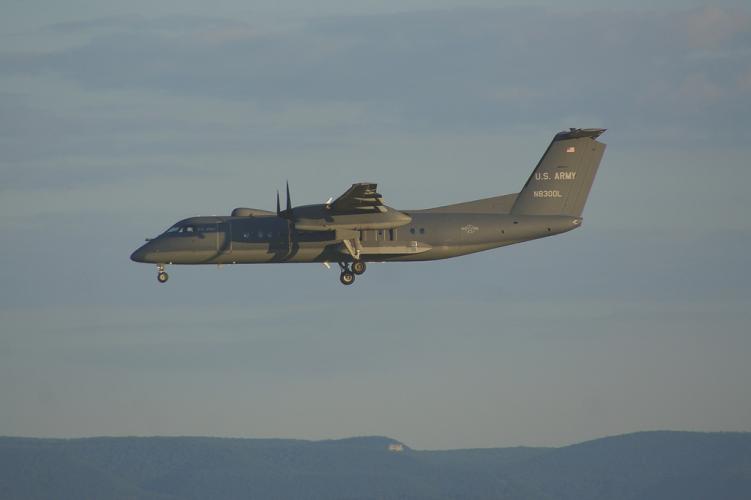
U.S. military DASH-8 aircraft. Wikimedia Commons
Caracas, Nov 8 (EFE).– The Venezuelan Defense Ministry on Sunday claimed that a U.S. DASH-8 military aircraft violated its maritime airspace and the armed forces of Caracas said they detected “unusual” air activity by other U.S. “intelligence equipment” based in Curacao.
The U.S. Coast Guard DASH-8, “equipped with an electro-optic system that allows the detection of thermal energy to create images, violated our airspace over the territorial waters created by Los Monjes,” a Caribbean archipelago, said Defense Minister Gen. Vladimiro Padrino.
The Venezuelan army general said that the violation occurred last Friday and that the complaint “was transmitted to the Foreign Ministry for the appropriate action.”
The U.S. plane “flew in a reconnaissance pattern and orbited the southern portion of Los Monjes, in the Gulf of Venezuela, and flew circular search patterns,” said Padrino in a televised speech from the Venezuelan presidential palace.
In addition, he said that “intelligence aircraft of the United States … based in Curacao approached our area of influence in an unusual manner,” specifying that these planes were RC-135 aircraft used to take photos and gather intelligence data, reiterating that their activity “is completely unusual.”
The RC-135’s were accompanied by a larger aircraft, a “C-17 Globemaster,” which is a heavy military transport plane used for ferrying troops, paratroops and supplies, he said.
This unusual military activity, Padrino said, attracted the attention of the Venezuelan armed forces and comes in the run-up to the Dec. 6 legislative elections, adding that the U.S. aircraft carrier George Washington “coincidentally will be very close to us on the day of the elections,” although he said he did not want to be alarmist about the situation.
The George Washington, with its fleet of fixed-wing aircraft and helicopters travels accompanied by “missile frigates, submarines and a whole platform of logistics vessels,” Padrino said.
The United States and Venezuela have not had ambassadors in each other’s capitals since 2010, but the two countries have had a testy diplomatic relationship since the late former President Hugo Chavez came to power in 1999, and that tension has continued under his successor, Nicolas Maduro. EFE
A few weeks ago, The Costa Rica Star reported a similar situation related to U.S. military aircraft in our country:
A Lockheed P-3 Orion and a Hercules C-130 from the United States Coast Guard should not be allowed to enter Costa Rican airspace for the purpose of flying drug interdiction missions. Such was the statement made by Enio Cubillo, Director of Civil Aviation in Costa Rica, in a memorandum presented to the Chancellor General this week.
The two airplanes in question are part of Operation Martillo (Hammer) and the Joint Patrol Agreement between the U.S. and Costa Rica. This operation, which involves military forces of other nations from the Americas, is part of the War on Drugs, and it aims to fight drug trafficking from South America to Mexico and the United States, the largest marketplace for controlled substances such as marijuana, cocaine, heroin, etc.
Prior to ordering the U.S. Coast Guard aircraft away until legislative permits are issued, two Sikorski UH-60 Black Hawk helicopters, allegedly configured as HH-60 combat rescue aircraft for service in the United States Air Force, were seen flying over the community of La Palma, not far from Ciudad Neilly in the southern region of Costa Rica. It was later determined that those two rotary wing aircraft lacked the aforementioned legislative permits.



