


 SIGN UP FOR OUR
A multi-agency commission charged with improving things at the Costa Rica’s main international airport has identified priority areas in their first two months of work.
Costa Rican Tourism Minister Mauricio Ventura said the commission detailed “seven internal problems at the airport, for which measures were proposed over the short and medium term.” He was enthused at the speed at which the commission was identifying issues and proposing ready-to-implement solutions to make for a more pleasant travel experience at the airport.
The Juan Santamaria Airport in Alajuela, 20 minutes outside of San Jose, Costa Rica has struggled to keep up with the steady growth in tourist arrivals which last year burgeoned to over 1.5 million through the terminal.
The actions will allow the airport to be functioning at 100 percent of its operational capacity by November, said a report presented by Ventura to the country’s Presidential Council of Competitiveness.
To aid in easing transit through the facility for visitors and citizens alike, Ventura called together the commission comprised of representatives from the General Directorate of Civil Aviation, the Immigration and Aliens Department, AERIS – the company operating the airport, the Airline Association, and the Air Surveillance Service.
According to Ventura, the bulk of the priority problems identified can be solved with the recommendations of the commission because they primarily relate to staffing and procedures such as scheduling that affect the terminal’s operational capacity.
The changes to take place in the upcoming months may not all be readily visible, but most should be felt by travelers who may find lines are shorter and the experience smoother.
- Immigration. The Immigration and Migration Directorate will start a pilot program with an additional 10 booths for travelers to check on any exit impediments, permits for minors or other migration-related concerns.
- Changes in personnel. The General Directorate of Civil Aviation is adjusting personnel in the baggage review area. Air surveillance personnel will no longer be in this area, but rather be located at other key areas such as passenger and cargo entry points where they are more needed in their role.
- Staff scheduling changes. During peak season and other buy transit times, 22 additional migration officials will be brought on to assist.
- Reduced paperwork. As of August, the paper form given to people to fill out when entering the country will be eliminated. Airlines said they felt information collected was not useful nor verifiable, as passengers can simply make up personal information.
- Computer systems and back ups. Protocols were established to minimize failures of computer systems and to avoid delays in registering passengers, and thus aid in maintaining punctual flight departures. This year there have been six computer system failures – some were due to system errors and others to migration and judiciary database errors.
- External problems. Three problems outside the airport were also identified by the commission. These include accessibility problems from the highway, backups at highway toll booth and at traffic lights, and highway congestion on roads approaching the airport.
- Phytosanitary and customs controls. The commission is developing a procedure that involves coordination between institutions to ensure a customs processing time of no more than 16 – 20 minutes for those bringing in merchandise or other regulated items. The office is located near the airport exit.
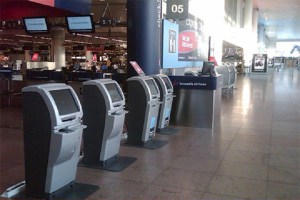
Finally, the commission is recommending the installation of self-service electronic kiosks to expedite the entry of Costa Ricans into the country.
The kiosks are similar to automatic teller machines and use biometrics: travelers insert their passport and also place their hands on the screen for fingerprint scans to facilitate their entry into the country. The SJO airport aims to have 20 such self-service electronic kiosks available in the future.
“The funds are available and the investment will aid in safety and agility,” Ventura explained. The Immigration and Foreign Affairs Directorate initiated talks with banks that process passports to coordinate the use of databases that would be used by the kiosks. This technology will also be applied later at Daniel Oduber Airport, said Ventura.



