


 SIGN UP FOR OUR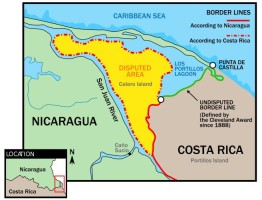
Wikimedia Commons
San Jose, Dec 16 (EFE; additional context by The Costa Rica Star).– The Nicaraguan government said Wednesday that it acknowledges and will abide by the decision of the International Court of Justice at The Hague putting an end to two border disputes with Costa Rica, decisions that recognize Costa Rican sovereignty over Isla Portillos.
The goverment hailed the ruling by the ICJ, which “concludes a page in the history of encounters and disagreements between the governments of Nicaragua and Costa Rica.”
As has been reported by The Costa Rica Star over the years, the 2010 international incident is called the Google Maps Invasion because Eden Pastora, an aging guerrilla fighter formerly known as Commander Zero, produced Google Maps printouts to justify the bivouac set up in Costa Rica by the armed Nicaraguan security forces who accompanied him on a dredging operation of the San Juan River.
When our Ministry of Foreign Affairs complained to Google, the search engine giant revealed that their mapping data on the region was obtained from the United States Department of State. All the same, it was incorrect information that Google quickly amended.
The coordinator of the Communication and Citizenship Council, Rosario Murillo, said that the Nicaraguan government finds in this ruling the sense of balance that has always characterized the decisions of the U.N. high court.
The government expressed in a statement read by Murillo that, for Nicaragua, it “is of great importance” that the ICJ recognized Managua’s full right to carry out dredging activities in the San Juan River.
It also said that the ICJ unanimously ruled that the Costa Rican government demarked and constructed a roadway parallel to the river, failing to fulfill its obligation to first perform an environmental impact study that would result in reducing damage to the local flora and fauna.
“Another important point included in the ruling is (Nicaragua’s) right to regulate … navigation on the San Juan River,” said the government, adding that now the two nations should resolve to “reestablish the mechanisms of dialogue and coexistence that allow us to ensure respect, tranquility and peace.”
Meanwhile, Costa Rican President Luis Guillermo Solis on Wednesday expressed his satisfaction with the “forcefulness” of the ICJ ruling finding that Nicaragua violated Costa Rican sovereignty.
“The resolution of the court fully satisfies (Costa Rica’s) national assessment that its territory was invaded by Nicaragua in an open act of illegality,” said Solis at a press conference.
The president said that “the majority of the propositions of Costa Rica were accepted unanimously and completely.”
The ICJ on Wednesday ruled in favor of Costa Rica in its border dispute with Nicaragua by recognizing Costa Rican sovereignty over Isla Portillos (also known as Harbour Head Island) and concluding that Managua violated its territory with its military presence and its navigation rights in the San Juan River.
ICJ chief justice Ronny Abraham read the ruling on the case brought by Costa Rica in 2010 regarding an alleged military invasion and environmental damage to a portion of its territory protected by international treaties, and another by Nicaragua against the neighboring country in 2011 for alleged environmental damage to Nicaragua’s San Juan River during the construction of a road.
Abraham said that the court, in a 14-2 decision, acknowledged that “Costa Rica has sovereignty over the territory in litigation,” the riverine Isla Portillos, or Isla Calero, on the Caribbean coast.
The court unanimously found that Nicaragua violated Costa Rica’s territorial sovereignty by creating three river channels and establishing a military presence in Costa Rican territory in its attempt to link the San Juan River, over which Nicaragua has sovereignty, to the Caribbean Sea.
In its ruling, the ICJ confirmed that no proof exists that Costa Rica had caused environmental damage to the San Juan River in the construction of a road parallel to the waterway. EFE



