


 SIGN UP FOR OUR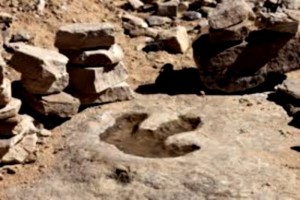
Jurassic footprints. Source: Wikimedia Commons
Madrid, Apr 28 (EFE).– The newly discovered Chilesaurus diegosuarezi, a 145-million-year-old dinosaur and the first from the Jurassic period discovered in Chile, is “one of the strangest found so far” and amounts to an “evolutionary puzzle,” one of the researchers who found the dinosaur’s fossil told Efe.
The discovery is described in the latest edition of the journal Nature, and one of the co-authors is Fernando Novas, who works at Argentina’s National Council for Scientific and Technical Research, or Conicet, and studied the specimen’s bones.
C. diegosuarezi was found in 2004 near General Carrera Lake in the southern Chilean region of Aysen by Diego Suarez, the 7-year-old son of Chilean geologists.
Novas told Efe that although the fossil is of a type of theropoda dinosaur, “it is the first representative of a lineage so far unknown” to scientists.
The group includes some famous carnivores, like the Velociraptor and the Tyrannosaurus, but Chilesaurus was an herbivore and its discovery supports theories that diet diversification toward vegetarianism was more common than previously thought among basal theropoda, the researchers said.
Approximately the size of a small horse, C. diegosuarezi’s arms were strong but its paws had only two short fingers ending with slightly curved claws not fit for hunting other animals.
Novas described Chilesaurus as “a cougar with a guanaco’s head and atrophied claws, like those of an ostrich.”
C. diegosuarezi’s anatomy has paleontologists perplexed since its hips resemble those of the ornithischia dinosaurs, which were strictly vegetarian, while the hind feet, wide and with four toes, are similar to those of more primitive dinosaurs.
This unusual combination of anatomical features poses “a true evolutionary puzzle,” Novas said, rejecting the possibility that the bones found in Chile were a mix of remains from different dinosaurs in the same area.
While he was hitting a rock with a hammer in search of fossils, young Diego Suarez found a vertebra a few centimeters long and a rib.
Further excavations turned up more than a dozen specimens “quite whole and articulated,” which dispels any doubts about this being other than one dinosaur with all those features, Novas said.
After Suarez’s find and once Argentine paleontologists Novas and Leonardo Salgado were contacted, a binational program of excavations in the area was carried out, leading to the collection of several bone fragments.
The fossils were taken to the Argentine Museum of Natural Sciences in Buenos Aires “and over the next few months, we saw how each of the bones emerged as parts of a wonderfully preserved skeleton,” Novas said.
Chilesaurus diegosuarezi may have been “a very strange animal,” but the abundance of remains found indicate it was one of the most common inhabitants of Patagonia some 145 million years ago, demonstrating that the history of dinosaurs “was much more complex than we imagined,” Novas said. EFE



