


 SIGN UP FOR OUR
 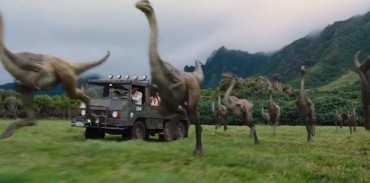 A few days after the much-anticipated trailer of Jurassic World, a summer blockbuster film expected to arrive in theaters next year, a website for the fictional amusement park located in the equally non-existent Isla Nublar of Costa Rica began operating. At first sight, www.jurassicworld.com provides visitors with lots of information on the park, from a brief bio of the founder to an interactive map and even the different extinct dinosaurs species brought back to life by the magic of fictional genetic engineering.
Strangely, there is no mention of Costa Rica on this website, at least not in passing. Once you click on the navigation icon of the shadowy Masrani corporation, however, the important role our country plays in the fictional Jurassic Park universe created by the late Michael Crichton is explained:
Clicking on the “About” section of www.masraniglobal.com, we learn about the social responsibility this mysterious firm seeks to practice at Jurassic World in Costa Rica. First, a bit of history on Isla Nublar (inspired by Isla del Coco):
Officially discovered in 1525 by Spanish navigator Diego Fernandez, the naming of Isla Nublar is often credited to cartographer Nicolas de Huelva, who, on the Spanish carrack La Estrella (The Star) described seeing a “cloud island” while mapping the western coast of Costa Rica.
The Spaniards learned the existance of a local indigenous tribe to the island, known as the Bribri tribe. The natives referred to the island locally as Guá-Si (Water House, or, House beyond Water) and themselves as Tun-Si (Water Men).
Then we learn about the wildlife and habitat conservation angle:
Around the coasts of Nublar hundreds of birds stop to rest on their long migrations. The largest being the Pelecanus occidentalis (Brown Pelican) whose impressive wing span reaches 8 feet in length on average.
The Masrani company, together with InGen, have worked together to ensure the protection of these animals. A historical agreement was signed in 2005 with the Costa Rican Environmental Protection Society to ensure the safety and habitat of the indigenous wildlife of Isla Nublar.
The inclusion of over 750 blue recycling bins across the island, including a local recycling facility, is testimony to the specific requirements set in place by the Costa Rican government and by the Costa Rican Environmental Protection Society.
Aside from operating Jurassic World, Masrani Corp also operates a unique telecommunications project in Costa Rica:
The Mascom family has been the longest running sector of Masrani. Established in 1973 with the birth of the company it has gone on to conquer the world with its advancements in communications. From utilizing the concept of fiber-optic communications systems back in 1979, reshaping the satellite phone industry in the 1990s, to bringing the world its first holographic mobile smart phone with the Tanius 7; Mascom has connected the world establishing itself as a leader of the avant-garde.
Lead Network Engineer: James McClure, of the Mascom Network, stands inside Mascom’s latest telecommunications facility in San José, Costa Rica.

While all of the above is clearly fictitious, that has not stopped analysts and nitpickers from pondering on how close or far from reality the Jurassic World plot can be. Earlier this year, The Costa Rica Star noted that the paleontological history of our country does not go as far back as the Jurassic period. More recently, a major news website from Australia noted that:
a dinosaur theme park built on a fictional island off Costa Rica would not be able to use the great white shark as “prehistoric wildlife food” under the UN Convention on the International Trade in Endangered Species of Wild Flora and Fauna (CITES), to which Costa Rica is a signatory.
“I presume that InGen (if they are still the IP and shareholders for Jurassic World), as a US-based company doing business in Costa Rica is obligated to operate within parameters dictated by Costa Rican law;.”



