


 SIGN UP FOR OUR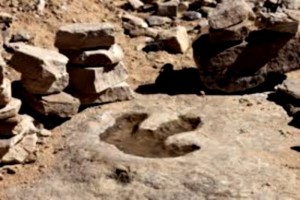
Jurassic footprints. Source: Wikimedia Commons
London, Jun 10 (EFE).- British scientists have found possible blood cells and collagen in the fossilized remains of a dinosaur dating back 75 million years, the journal Nature Communications reported.
Researchers found structures that might be red blood cells and other fibers similar to collagen in bones from the Cretaceous period, which lasted from the end of the Jurassic period some 145 million years ago to the early Paleocene period 65 million years ago.
The finding indicates that the preservation of soft tissue structures in fossils might be more common than previously thought.
Scientists had previously found soft tissue components, like cells and molecules similar to proteins, in other fossils tens of millions of years old, but only in well-preserved specimens.
The identification of the tissues was controversial in the scientific community.
For a long time, researchers have thought that protein molecules decompose in a short period and would not last more than 4 million years.
Sergio Bertazzo and Susannah Maidment, of Imperial College in London and the lead researchers on this study, reported the discovery of organic structures in the remains of eight dinosaurs that lived in the Cretaceous period at the end of the Mesozoic era.
Some bones from one of the dinosaurs contain structures similar to collagen, a protein with a characteristic helix formed by elongated fibrils and composed of essential amino acids.
The study results, if confirmed, might be crucial for paleontologists, opening the door to a better understanding of the pre-historic reptiles’ biology and the relationship among different species.
Bertazzo has counseled caution about the findings and said further study was required to corroborate that “what we are looking at are dinosaur fragments.” EFE



