


 SIGN UP FOR OUR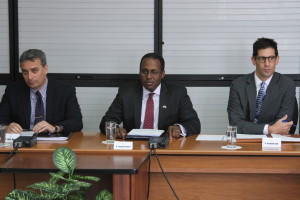
US Ambassador Haney. Source: Legislative Assembly of Costa Rica
Without security, there can be no development in Costa Rica. Such was the emphasis posited by United States Ambassador S. Fitzgerald Haney as he appeared before the Permanent Commission on Foreign Affairs and Trade of the Legislative Assembly on the last Friday of October.
Ambassador Haney mentioned that there is a priority at the Embassy and at the U.S. State Department to support economic development and growth in Costa Rica because it benefits the North American nation. The Ambassador also mentioned that the U.S. has many economic interests in our country, and thus economic growth is a mutual benefit.
Development is not limited to exporters and sectors involved in trade, the Ambassador explained as he spoke of all-inclusive development that involves other sectors that already have commercial ties between the U.S. and Costa Rica.
On the topic of crime and violence, the Ambassador mentioned that this is an important priority for both nations; he explained that if the U.S. and Costa Rica are not able to provide safe communities, the development goals cannot be achieved and the desired future outcomes may not be obtained.
Days prior to his appearance before the Legislative Assembly, the Ambassador spoke to daily tabloid Diario Extra of his concern over the slow issuance of permits for U.S. military aircraft, vehicles and vessels to enter Costa Rica. He said that any decision made by the Costa Rica government and from the Legislative Assembly will be heeded in this regard, but he added that it would be easier for the U.S. if the process would not be so bureaucratic. He specifically pondered: What if a situation were to develop on a Sunday and no one is at the Assembly to issue a permit?
The issue of legislative permits for armed U.S. military forces to enter Costa Rica has been an item of much contention in the last few years, and it was exacerbated in recent weeks by various landings of Black Hawk helicopters in our country as well as the order of two U.S. Coast Guard aircraft to not enter our airspace without permission.
In the case of the U.S. Coast Guard aircraft, they are part of the U.S. War on Drugs, specifically Operation Martillo, an international effort to combat drug trafficking from South America and through the Caribbean and Central America before reaching the lucrative U.S. market, where high demand and myriad distribution channels await.
Legislator Rafael Ortiz, who currently presides the Legislative Assembly for the Social Christian Unity (Spanish acronym: PUSC) faction, does not share the view of the U.S. Ambassador insofar as the bureaucratic tardiness in issuing such permits. The Legislator explained to Diario Extra that whenever they receive requests from the U.S. to allow military forces, such petitions are prioritized at the Assembly; if anything, he believes that the U.S. Embassy is not being very efficient in this regard:
The Embassy is the one that has to streamline the process. For example, if we are given a list of 20 ships that intend to dock in our ports between June and October, then they should also add the aircraft to that list instead of doing it one at a time.
Legislator Ortiz added that it would be optimal to issue permits for an entire quarter in advance instead of whenever the U.S. feels like it, which often results in backdoor approvals such as with the Black Hawk helicopters.



