


 SIGN UP FOR OUR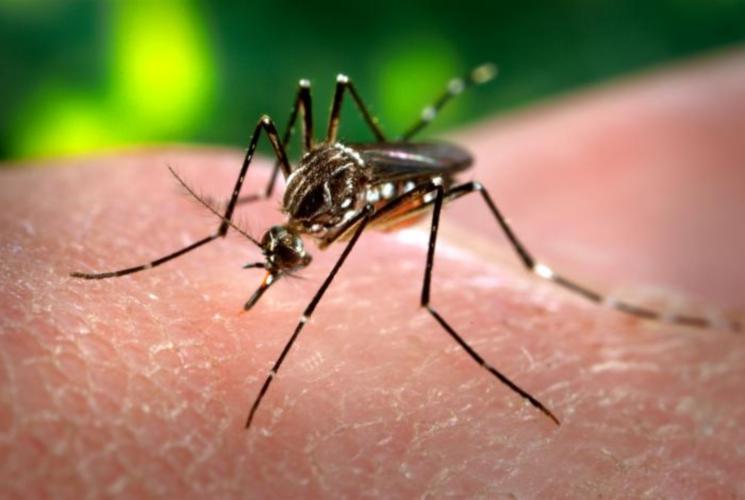
Zika is spread by the Aedes aegyptie mosquito (Wikimedia Commons)
Costa Rica’s Ministry of Health has declared a health emergency in the canton of Nicoya, Guanacaste and is considering declaring a national health emergency after two fully confirmed cases of Zika were detected in two women in Samara, the ministry announced at a press conference late Monday afternoon. One of the women is pregnant and close to giving birth, health officials said.
Fortunately, ultrasound examinations have determined that the woman’s unborn child does not have microcephaly, a condition linked to the virus and which causes babies to be born with abnormally small heads and brains.
Health officials said that both women contracted the virus locally, marking the first fully confirmed cases of indigenous transmission of the virus in Costa Rica.
Health officials warned pregnant women to avoid visiting the canton of Nicoya, in the northwestern province of Guanacaste, especially Samara and the surrounding area.
The cases will likely put an end to a petition sent by Costa Rica to the World Health Organization (WHO) two weeks ago, asking to be removed from the list of nations with active, indigenous transmission of the virus.
On February 2nd, the US Centers for Disease Control (CDC) included Costa Rica in a list of countries where Americans should avoid travel as a result of the virus, after a tourist from the United States fell ill with the virus after visiting the country. The WHO followed suit three days later.
While many Costa Rican health officials have described as “likely” that the tourist did in fact catch the virus while visiting Costa Rica, officials had said that the case could not be fully confirmed.
The tourist had visited the same area where the two cases announced on Monday occurred.
Besides the US tourist, and prior to the two cases announced on Monday, Costa Rica had seen only two other confirmed cases of Zika, both imported from abroad. One case was confirmed in a Costa Rican man who had returned from a trip to Colombia, where he is believed to have contracted the virus. The second case was in a man who was visiting from Honduras.
Worst case scenario
Medical epidemiologist and newly-appointed coordinator of Costa Rica’s National Disease Vector Control Program, Rodrigo Marin Rodriguez said that Costa Rica could see up to 60,000 cases of Zika infection in a worst case scenario in an interview published by the daily La Nacion on January 29th.
Marin bases his “worst case” scenario – should an outbreak occur – on estimates from Colombia, which currently has an indigenous outbreak of Zika and where conditions are very similar to Costa Rica.
According to Marin, officials there expect 600,000 cases of Zika and 500 cases of microcephaly, in a country of 50 million inhabitants. Given the similarities between the two countries, Marin thus estimates that Costa Rica could see some 60,000 Zika cases amongst the country’s 5 million inhabitants.
Marin said that the government plans to aggressively eliminate mosquito breeding sites throughout the country, but urged the public to also do their part in ensuring to eliminate mosquito breeding sites in and around their homes, and to take all measures possible to avoid mosquito bites.



